
Home » 2024
Yearly Archives: 2024
Eggstraordinary Art: A New Book Just Released on Egg Decorating
Once a year for at least a week, my kitchen and dining room become a frenzied artist’s workshop full of dyes, the smell of melting beeswax, and a variety of tools. I go on a hunt for white chicken eggs to ethnic shops (and chicken farms!) and buy as many as I can, and spend my days hunched over the delicate eggs, painstakingly fashioning each egg into a work of art. Each year I try a new technique or style, searching for design inspirations that surpass the creations of the year before. Some of the eggs take several hours, depending on the tradition in which they are designed. Decorating eggs this way for Easter is a family and ethnic tradition. I have been decorating since childhood, and over the years I have amassed a collection of my favorite ones. Many of the eggs are given as gifts. For the past decade, I have taken photos of them and shared them with the Lithuanian community.
These photos are now published in my new book Eggstraordinary Art: Beautiful Eastern European Eggs for Easter. It is available now worldwide on Amazon.

Click here to go to the sales website.

The eggs in this photo are decorated in traditional Lithuanian style using the drop-pull method. But I have also learned the Ukrainian method, which is far more intricate. The book includes descriptions of these traditions and a photo gallery.

Understanding Openness to Change among Lithuanian Generations
VALUEHOST is a three-year research project funded by the Lithuanian Research Council. We explore changing Lithuanian values, with a focus on emigrants and their experiences in their host countries. In this post, I introduce some interesting findings from one of our studies on changing values at home.
We have analyzed data between the years 2010-2020, from the European Social Survey database on individuals’ values. In this study, we were interested in exploring whether values can change in the short term. Scholars have long held that values are enduring, and that they are very slow to change. In societies, this change would be steady, and progressive over generations. Typically, we notice these differences by comparing our own values with those of our parents’ generation.
But much of the research on values change has been in the context of relatively stable advanced economies. Generations here have labels which we all know: Baby Boomers, Gen X, Gen Y, etc. Societies in the former USSR, though, have had different social, political, and economic transformations. Their process of modernization has been quite different.
In our study, we distinguish between generations which we link to political eras. People who grew up in these different eras in Lithuania acquired their values during vastly different historical periods. Some periods were more turbulent than others. We label them the Stalin generation for individuals born before 1945. The Soviet generation includes those born between 1945 and 1969. The late Soviet generation comprises those born from 1970 to 1989. The Independent EU generation includes individuals born after 1989. One of our aims was to compare the values of these different political generations to one another and over time.
Here we look at one of the results on Openness to Change values, derived from the work of Shalom Schwartz. This is a measure that combines three personal values: self-direction, stimulation and hedonism. Self-direction encompasses the extent to which individuals value independence in thought and action. Stimulation reflects how much people value excitement, novelty and challenges in life. And hedonism refers to the pursuit of personal pleasure or immediate gratification.
We compared six rounds of surveys across more than 11,000 individuals, starting in 2010, and every two years thereafter.

In the figure, we can see that openness to change appears to fluctuate over the years. Some generations are quite similar, but one stands out – the Independent EU generation. These are individuals, who, at the time of the survey, were between the ages of 18 and 30. For the other generations, openness to change declines slightly but increases over time by survey round 10 in 2020. We see the opposite in the youngest generation. Here, openness to change declines steadily over the years. In the final survey round, there is a slight increase. But overall, openness to change has declined for this generation during the 10 years up to 2020.
We would be interested in hearing your thoughts about why this has happened.

Narcissistic CEOs: Strategies for Entrepreneurial Success

Our latest article has just been published in the International Small Business Journal. Have you ever worked with someone who is at times charismatic and charming and at other times nitpicky, controlling and lacking in empathy? A coworker or manager who likes to brag about themselves, their achievements, successes and ambitions to be the best of the best, yet is also often insecure, envious, and manipulative? They instigate office drama and act as the center of attention. They crave glory. They are difficult to work with yet have their superiors, clients, and partners charmed. That coworker or boss likely has narcissistic tendencies.
Our study focuses on CEOs with these types of personality traits.
We analyze the tendencies of narcissistic CEOs to engage in acquiring, developing, and protecting resources. We examine how these behaviors translate to fulfilling their grandiose entrepreneurial strategies. Essentially, narcissistic CEOs are resource hogs. This helps them weather uncertain times, and when threatened, they are further activated to try (and succeed at their) innovative, proactive, and risky strategies.
“It’s all about resources: Narcissistic CEOs and entrepreneurial orientation during disruptions” by Richa Chugh from the Victoria University of Wellington, Audra I. Mockaitis from Maynooth University, Stephen E. Lanivich, University of Memphis, and Javad E. Nooshabadi, Maynooth University, was published in September, 2024.
The article is FREE to access: https://doi-org.may.idm.oclc.org/10.1177/02662426241269774
We would be interested to hear your thoughts about our publication.
Explore the Elgar Encyclopedia of Cross-Cultural Management
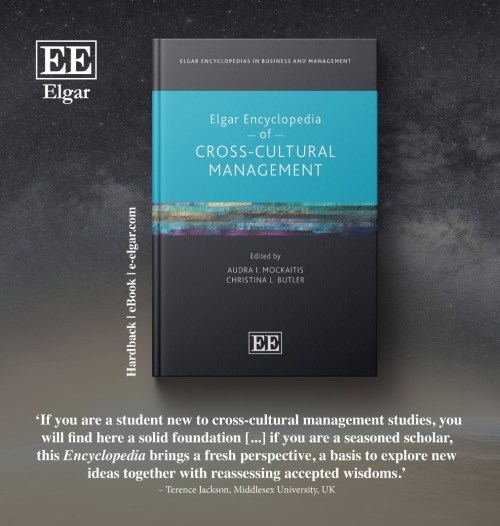
The Elgar Encyclopedia of Cross-Cultural Management is available now! Access the first chapter and introductory content for FREE here.
The Elgar Encyclopedia of Cross-Cultural Management, edited by Professor Audra I. Mockaitis (Maynooth University) and Professor Christina L. Butler (Kingston University), is the first reference book of its kind in the field. The book reflects the eclectic and interdisciplinary nature of cross-cultural management. It includes entries from scholars in cross-cultural psychology, business and management, anthropology, linguistics, sociology, and political science. These contributions form a collective discourse about the evolution and trajectory of the field. Authors present a range of perspectives, theories, and concepts. They challenge traditional paradigms. Together, they offer new multi-paradigmatic explanations to cross-cultural phenomena. Suitable for scholars, students and practitioners, the collection presents the state-of-the art in the cross-cultural management field.

Elgar Encyclopedia of Cross-Cultural Management Launching in October 2024
The presses are still hot as a new book is coming out in October, 2024. Edited by me and Professor Christina L. Butler from Kingston University, UK, the Elgar Encyclopedia of Cross-Cultural Management is the first reference book of its kind in the field.

The book reflects the eclectic and interdisciplinary nature of the field of cross-cultural management, with entries from scholars in the cross-cultural psychology, business and management, anthropology, linguistics, sociology, and political science disciplines, contributing to a collective discourse about the evolution and trajectory of the field. Authors present a range of perspectives, theories, and concepts, challenge traditional paradigms, and collectively offer new multi-paradigmatic explanations to cross-cultural phenomena.
Suitable for: scholars from various disciplines, as a guide to new developments in the field; students in any major that has a cross-cultural component to the curriculum (e.g., psychology, management, international business, sociology….) as a useful reference; and anyone with a curiosity about cross-cultural management.
The collection presents the state-of-the art in the cross-cultural management field. Written by eminent scholars from across the globe, entries include summaries, commentaries, and new perspectives on both theory and research. There are 78 chapters, or entries, in eight subject groups:
- Conceptualizations and Components of Culture
- Similarities and Differences across Cultures
- Interacting across Cultures
- Developing Cultural Awareness
- Cultural Identity and Diversity
- The Cross-Cultural Management of People
- Organizational and Institutional Perspectives
- Perspectives on Cross-Cultural Management
Available to purchase on the publisher’s website , AMAZON, Barnes & Noble, and other places!
ISBN: 978 1 80392 817 3
 Professor Audra I. Mockaitis