
Home » Migration
Category Archives: Migration
Diaspora & Cultural Identity
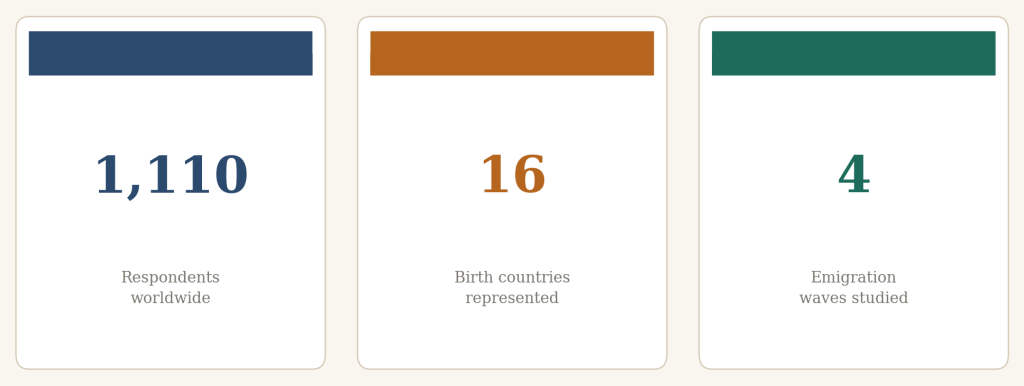
I surveyed over 1,100 Lithuanian migrants worldwide expecting to find cultures drifting apart across generations. What we found was more surprising.
The story we usually tell about diaspora goes something like this: a people displaced from their homeland carry its culture with them, transmit it to their children, and over generations it slowly fades as they assimilate into their host countries. The Lithuanian diaspora, consisting of waves of wartime refugees, Soviet-era exiles, and more recent economic migrants scattered across continents, seemed to be the perfect setting for testing that story. It turned out to complicate it considerably.
What we found
We measured individual-level cultural values across five dimensions: collectivism, uncertainty avoidance, power distance, masculinity, and long-term orientation, comparing Lithuanian-born migrants, foreign-born diaspora members, and nonemigrant home country nationals.
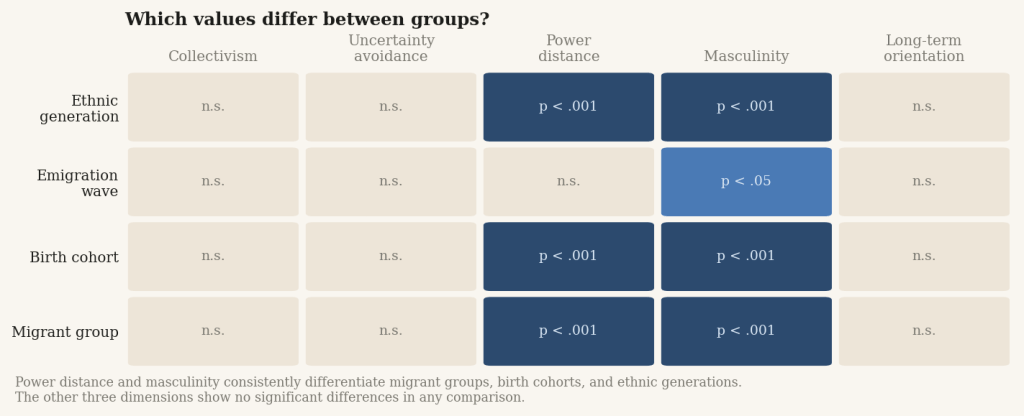
On three of the five dimensions, the groups were strikingly similar. Collectivism, uncertainty avoidance, and long-term orientation showed no significant differences across generations, emigration waves, or migrant groups. Values that one might expect to erode over decades of living abroad appear, instead, to hold.
Three of five cultural values showed no significant differences between migrants and nonemigrants, regardless of how long ago, or from where, people left.
The differences that did emerge were on power distance and masculinity. Lithuanian-born migrants score higher on both than foreign-born diaspora members, and the generational pattern is clear: older cohorts, who came of age under Soviet rule or post-independence economic turbulence, endorse hierarchy and assertiveness more strongly than younger cohorts socialized in more open, prosperous conditions. This is consistent with what we know about values formation: people carry the imprint of the world they grew up in.
The bigger question
Perhaps the most counterintuitive finding is about timing. We might expect post-war diaspora members, who have been separated from Lithuania for decades, unable to return, to have drifted furthest from home country values. They have not, at least not on most dimensions. The differences between emigration waves are modest. What appears to matter more than when people left is the simple fact that they left at all: migrants as a group differ from nonemigrants in consistent ways, regardless of wave or generation.
This has implications well beyond the Lithuanian case. International business research routinely treats national culture scores as if they describe a homogeneous group. Behind any national average lie subgroups shaped by radically different histories – people who fled, people who chose to go, people born abroad to parents who fled. Collapsing those distinctions into a single number discards exactly the variation that tells us something interesting about how culture actually works.
See:
Mockaitis, A.I., & Zander, L. (2023). Dissecting generations of migrant identities within a diaspora. In: A.I.Mockaitis (Ed.). The Palgrave Handbook of Global Migration in International Business, Palgrave Macmillan, Cham. https://doi.org/10.1007/978-3-031-38886-6_6

Understanding Openness to Change among Lithuanian Generations
VALUEHOST is a three-year research project funded by the Lithuanian Research Council. We explore changing Lithuanian values, with a focus on emigrants and their experiences in their host countries. In this post, I introduce some interesting findings from one of our studies on changing values at home.
We have analyzed data between the years 2010-2020, from the European Social Survey database on individuals’ values. In this study, we were interested in exploring whether values can change in the short term. Scholars have long held that values are enduring, and that they are very slow to change. In societies, this change would be steady, and progressive over generations. Typically, we notice these differences by comparing our own values with those of our parents’ generation.
But much of the research on values change has been in the context of relatively stable advanced economies. Generations here have labels which we all know: Baby Boomers, Gen X, Gen Y, etc. Societies in the former USSR, though, have had different social, political, and economic transformations. Their process of modernization has been quite different.
In our study, we distinguish between generations which we link to political eras. People who grew up in these different eras in Lithuania acquired their values during vastly different historical periods. Some periods were more turbulent than others. We label them the Stalin generation for individuals born before 1945. The Soviet generation includes those born between 1945 and 1969. The late Soviet generation comprises those born from 1970 to 1989. The Independent EU generation includes individuals born after 1989. One of our aims was to compare the values of these different political generations to one another and over time.
Here we look at one of the results on Openness to Change values, derived from the work of Shalom Schwartz. This is a measure that combines three personal values: self-direction, stimulation and hedonism. Self-direction encompasses the extent to which individuals value independence in thought and action. Stimulation reflects how much people value excitement, novelty and challenges in life. And hedonism refers to the pursuit of personal pleasure or immediate gratification.
We compared six rounds of surveys across more than 11,000 individuals, starting in 2010, and every two years thereafter.

In the figure, we can see that openness to change appears to fluctuate over the years. Some generations are quite similar, but one stands out – the Independent EU generation. These are individuals, who, at the time of the survey, were between the ages of 18 and 30. For the other generations, openness to change declines slightly but increases over time by survey round 10 in 2020. We see the opposite in the youngest generation. Here, openness to change declines steadily over the years. In the final survey round, there is a slight increase. But overall, openness to change has declined for this generation during the 10 years up to 2020.
We would be interested in hearing your thoughts about why this has happened.
The Palgrave Handbook of Global Migration in International Business
I have recently published a new book.

The Palgrave Handbook of Global Migration in International Business (Audra I. Mockaitis, Ed.) presents novel research on various migration issues in the field of international business. The anthology contains 24 chapters, organized on five key themes representing perspectives and challenges borne by global migration within societies, firms, and individuals. Collectively, the authors examine global migration via the international business lens and present theoretical and practical solutions to a global grand challenge that is rapidly increasing in importance.
The five key themes of the book are:
Theme I: Migration Landscapes in International Business
Theme II: Navigating the Terrain of Language and Culture
Theme III: Leveraging and Managing Migration in the International Firm
Theme IV: Migrants as an International Business Resource
Theme V: The Migrant’s Journey
The book is written for a wide audience;. Researchers, scholars, international business professionals, policymakers, government organizations and NGOs working with migrants (refugees, skilled and unskilled immigrants) or migration issues, students and readers with a general interest in global migration-related topics will find something of interest in the book. The 59 authors are all experts in their fields and all conduct research on migration issues. Notably, while the authors reside in and represent various institutions in twelve countries, many of them are migrants themselves and have first-hand experience of many of the issues presented in the book.
See the Publisher page for more information and to download free sample chapters.
Interested in this book? Available to buy on:



The Book is available in Hardcover (ISBN : 978-3-031-38885-9), Softcover (ISBN: 978-3-031-38888-0) and eBook (ISBN: 978-3-031-38886-6).
VALUEHOST

An invitation to take part in a research study.
We are conducting a 3-year research study on Lithuanian values. We are interested in Lithuanians who have emigrated from Lithuania and are currently living in another country. We would like to learn whether living in another country shapes individuals’ personal values and in what ways. We are interested in the factors that shape our values. Importantly, do individual values change as a result of living in a new country? How long does this process take? Are the values of Lithuanians living abroad different from nonmigrant Lithuanians?
Have you emigrated from Lithuania?
Do you permanently live in any of the following countries?
✔ USA ✔ UK ✔ IRELAND ✔NORWAY ✔ GERMANY
Then we are interested in your experiences. Please click to take the survey.
This project is funded by the Lithuanian Research Council.
Read some of our previously published papers on migrant values.
Our paper on Lithuanian migrants and values has found a relationship between values and intentions to emigrate.
We have also analyzed the values of members of the Lithuanian diaspora. We found both similarities and differences in values between foreign-born Lithuanians and both Lithuanian emigrants and nonmigrant Lithuanians. Read the paper.
The Research Team:
Prof. Audra Mockaitis (PI), Prof. Vilmantė Kumpikaitė-Valiūnienė, KTU , Dr Vilmantė Liubinienė, Dr Jurga Duobienė, Dr Ineta Žičkutė, Irma Banevičienė

Migration Culture: A Comparative Perspective
Our new study on migration with a focus on countries that have a long or impactful history of migration has been published!
I am pleased to have collaborated with a group of authors of a new book, Migration Culture: A Comparative Perspective. We analyze the emergence of migration cultures at a societal level. Why are some societies more mobile and characterized by more deeply-rooted migration traditions than others? We suggest that environmental and institutional factors, and the evolution of societal-level values throughout certain periods in a country’s history, in combination, explain why migration in these societies becomes enmeshed with culture and in itself becomes a value.

More information about this publication can be found on the publisher’s website here.
Details:
Kumpikaite-Valiuniene, V., Liubiniene, V., Zickute, I., Duobiene, J., Mockaitis, A.I., & Mihi-Ramirez, A. (2021). Migration Culture: A Comparative Perspective. Cham, Switzerland: Springer.
ISBN 978-3-030-73013-0
ISBN 978-3-030-73014-7 (eBook)
 Professor Audra I. Mockaitis