
Home » Research
Category Archives: Research

The Silence Syndrome: What Multinationals Get Wrong About Corporate Language
New research on corporate language, socialization, and the conditions under which knowledge actually transfers
Picture this: a U.S.-based subsidiary in Shanghai introduces “English-only Fridays” to encourage use of the corporate language. The result is not better communication. It is silence. Employees disengage, avoid conversations, and curtail the very knowledge-sharing the policy was designed to promote. Researchers have called this the “silence syndrome,” and it captures a problem that far too many multinationals encounter without fully understanding.
Our new study published in the Asia Pacific Journal of Management sets out to explain why corporate language mandates so often fail to deliver on their promise, and what organizations should do instead.

The policy versus the practice
The study draws on data from 132 subsidiaries of foreign MNEs operating in Jiangsu Province, China, representing parent firms from 22 countries across Europe, Asia, North America, and Australia. Its starting point is a distinction that sounds simple but has substantial implications: there is a meaningful difference between formally adopting a corporate language and actually using it. Most of the literature has treated these as the same thing. They are not.
The formal adoption of a corporate language, typically English, is a top-down directive. It specifies what language communication should happen in. What it does not do is ensure that the resulting communication is meaningful to those on the receiving end. Subsidiaries can comply with such policies on paper while the practical reality on the ground looks quite different, a phenomenon organizational scholars have called ceremonial adoption. Our data show that formal adoption is actually negatively associated with communication quality. The mandate, in other words, can make things worse before it makes them better.
The relevance problem
To make sense of this, the study applies relevance theory, drawn from linguistics, to the organizational context. The core insight is straightforward: for communication to be effective, recipients must perceive the information as relevant, which means it must be cognitively accessible and contextually meaningful, not merely linguistically comprehensible. A message delivered in a language you are uncomfortable with, about practices whose organizational rationale you do not fully grasp, does not transfer knowledge. It generates cognitive burden and communicative withdrawal.
This reframes the challenge for MNEs considerably. The question is not simply which language to use but whether the information being communicated lands as relevant to subsidiary employees. That depends on communication quality, on socialization, and on employees’ actual proficiency in the corporate language, and these three factors interact.
What the findings show
Three empirical findings stand out. First, while formal corporate language adoption does not directly improve communication quality, high-quality communication does significantly improve knowledge transfer. The practical implication is that MNEs need to invest in how information is conveyed, not just in which language it is delivered. Clarity, contextual fit, and directness matter. Expatriate managers in high-context environments like China need to tailor communication to local cognitive frameworks, not simply translate headquarters messages and transmit them downward.
Second, when host country nationals actually use the corporate language in their daily interactions, this generates higher levels of socialization, both formal and informal, which in turn drives knowledge transfer. The causal pathway matters: it is not language use per se that helps transfer knowledge, but the social interactions that language use opens up. Joint meetings, cross-national teams, shared training programs, socializing during and outside working hours are the mechanisms through which knowledge becomes meaningful and transferable. Importantly, socialization substitutes to some extent for high-quality formal communication. Subsidiaries with rich socialization depend less on the clarity of formal channels because informal interaction fills in the contextual gaps.
Third, and perhaps most counterintuitively, language proficiency moderates these processes in ways that complicate the standard managerial prescription. The socialization pathway is most important precisely in subsidiaries where proficiency is lower. Where employees struggle with the corporate language, face-to-face interaction and deliberate socialization become more, not less, critical. Waiting until proficiency improves before investing in socialization is the wrong sequence. The research also finds that a high level of proficiency is not a prerequisite for effective knowledge transfer; employees can engage productively through socialization even with imperfect command of the corporate language.
What this means in practice
For MNEs operating across significant linguistic and cultural distance, these findings reframe the managerial task. Language training remains valuable, but it should be designed around high-relevance, practically grounded skills rather than formal proficiency benchmarks. More importantly, organizations need to build the social infrastructure through which language becomes a vehicle for shared meaning rather than a barrier to it. In the Chinese context specifically, this means attending to guanxi, to the development of personal relationships between expatriates and host country nationals, and to the creation of deliberate opportunities for interaction that bridge the in-group/out-group dynamics that can otherwise shut down knowledge exchange.
The broader lesson is simple but easy to overlook. A language mandate tells employees what to speak. It cannot, on its own, ensure they are actually heard.
Read more: Mockaitis, A.I., Tan, J., Zhu, J., Zhu, C.J., & Chen, Z. (2026). Corporate language and knowledge transfer in MNE subsidiaries: A relevance lens. Asia Pacific Journal of Management. https://doi.org/10.1007/s10490-025-10063-z
Diaspora & Cultural Identity
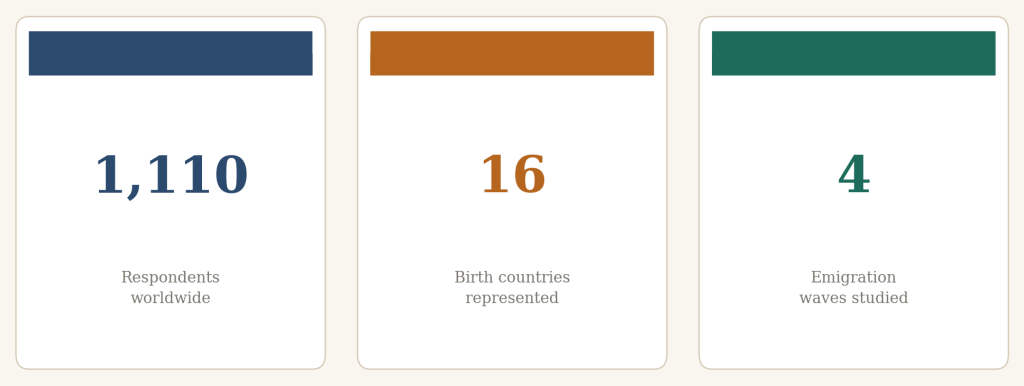
I surveyed over 1,100 Lithuanian migrants worldwide expecting to find cultures drifting apart across generations. What we found was more surprising.
The story we usually tell about diaspora goes something like this: a people displaced from their homeland carry its culture with them, transmit it to their children, and over generations it slowly fades as they assimilate into their host countries. The Lithuanian diaspora, consisting of waves of wartime refugees, Soviet-era exiles, and more recent economic migrants scattered across continents, seemed to be the perfect setting for testing that story. It turned out to complicate it considerably.
What we found
We measured individual-level cultural values across five dimensions: collectivism, uncertainty avoidance, power distance, masculinity, and long-term orientation, comparing Lithuanian-born migrants, foreign-born diaspora members, and nonemigrant home country nationals.
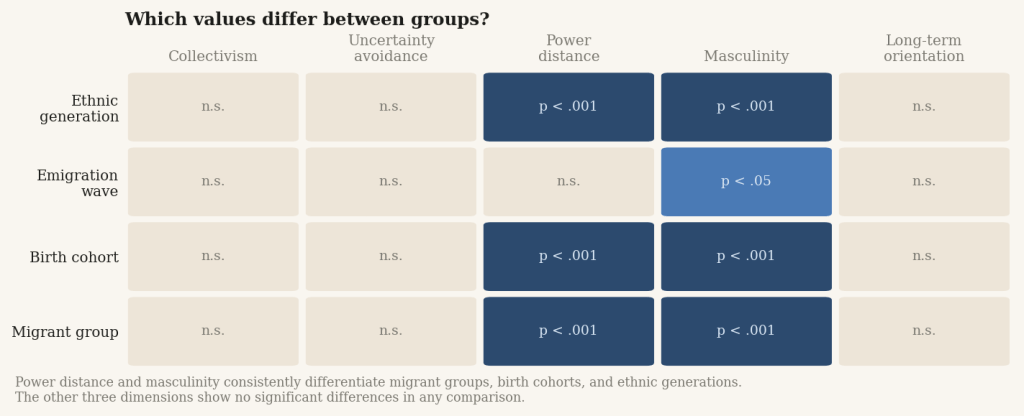
On three of the five dimensions, the groups were strikingly similar. Collectivism, uncertainty avoidance, and long-term orientation showed no significant differences across generations, emigration waves, or migrant groups. Values that one might expect to erode over decades of living abroad appear, instead, to hold.
Three of five cultural values showed no significant differences between migrants and nonemigrants, regardless of how long ago, or from where, people left.
The differences that did emerge were on power distance and masculinity. Lithuanian-born migrants score higher on both than foreign-born diaspora members, and the generational pattern is clear: older cohorts, who came of age under Soviet rule or post-independence economic turbulence, endorse hierarchy and assertiveness more strongly than younger cohorts socialized in more open, prosperous conditions. This is consistent with what we know about values formation: people carry the imprint of the world they grew up in.
The bigger question
Perhaps the most counterintuitive finding is about timing. We might expect post-war diaspora members, who have been separated from Lithuania for decades, unable to return, to have drifted furthest from home country values. They have not, at least not on most dimensions. The differences between emigration waves are modest. What appears to matter more than when people left is the simple fact that they left at all: migrants as a group differ from nonemigrants in consistent ways, regardless of wave or generation.
This has implications well beyond the Lithuanian case. International business research routinely treats national culture scores as if they describe a homogeneous group. Behind any national average lie subgroups shaped by radically different histories – people who fled, people who chose to go, people born abroad to parents who fled. Collapsing those distinctions into a single number discards exactly the variation that tells us something interesting about how culture actually works.
See:
Mockaitis, A.I., & Zander, L. (2023). Dissecting generations of migrant identities within a diaspora. In: A.I.Mockaitis (Ed.). The Palgrave Handbook of Global Migration in International Business, Palgrave Macmillan, Cham. https://doi.org/10.1007/978-3-031-38886-6_6

Understanding Openness to Change among Lithuanian Generations
VALUEHOST is a three-year research project funded by the Lithuanian Research Council. We explore changing Lithuanian values, with a focus on emigrants and their experiences in their host countries. In this post, I introduce some interesting findings from one of our studies on changing values at home.
We have analyzed data between the years 2010-2020, from the European Social Survey database on individuals’ values. In this study, we were interested in exploring whether values can change in the short term. Scholars have long held that values are enduring, and that they are very slow to change. In societies, this change would be steady, and progressive over generations. Typically, we notice these differences by comparing our own values with those of our parents’ generation.
But much of the research on values change has been in the context of relatively stable advanced economies. Generations here have labels which we all know: Baby Boomers, Gen X, Gen Y, etc. Societies in the former USSR, though, have had different social, political, and economic transformations. Their process of modernization has been quite different.
In our study, we distinguish between generations which we link to political eras. People who grew up in these different eras in Lithuania acquired their values during vastly different historical periods. Some periods were more turbulent than others. We label them the Stalin generation for individuals born before 1945. The Soviet generation includes those born between 1945 and 1969. The late Soviet generation comprises those born from 1970 to 1989. The Independent EU generation includes individuals born after 1989. One of our aims was to compare the values of these different political generations to one another and over time.
Here we look at one of the results on Openness to Change values, derived from the work of Shalom Schwartz. This is a measure that combines three personal values: self-direction, stimulation and hedonism. Self-direction encompasses the extent to which individuals value independence in thought and action. Stimulation reflects how much people value excitement, novelty and challenges in life. And hedonism refers to the pursuit of personal pleasure or immediate gratification.
We compared six rounds of surveys across more than 11,000 individuals, starting in 2010, and every two years thereafter.

In the figure, we can see that openness to change appears to fluctuate over the years. Some generations are quite similar, but one stands out – the Independent EU generation. These are individuals, who, at the time of the survey, were between the ages of 18 and 30. For the other generations, openness to change declines slightly but increases over time by survey round 10 in 2020. We see the opposite in the youngest generation. Here, openness to change declines steadily over the years. In the final survey round, there is a slight increase. But overall, openness to change has declined for this generation during the 10 years up to 2020.
We would be interested in hearing your thoughts about why this has happened.

Narcissistic CEOs: Strategies for Entrepreneurial Success

Our latest article has just been published in the International Small Business Journal. Have you ever worked with someone who is at times charismatic and charming and at other times nitpicky, controlling and lacking in empathy? A coworker or manager who likes to brag about themselves, their achievements, successes and ambitions to be the best of the best, yet is also often insecure, envious, and manipulative? They instigate office drama and act as the center of attention. They crave glory. They are difficult to work with yet have their superiors, clients, and partners charmed. That coworker or boss likely has narcissistic tendencies.
Our study focuses on CEOs with these types of personality traits.
We analyze the tendencies of narcissistic CEOs to engage in acquiring, developing, and protecting resources. We examine how these behaviors translate to fulfilling their grandiose entrepreneurial strategies. Essentially, narcissistic CEOs are resource hogs. This helps them weather uncertain times, and when threatened, they are further activated to try (and succeed at their) innovative, proactive, and risky strategies.
“It’s all about resources: Narcissistic CEOs and entrepreneurial orientation during disruptions” by Richa Chugh from the Victoria University of Wellington, Audra I. Mockaitis from Maynooth University, Stephen E. Lanivich, University of Memphis, and Javad E. Nooshabadi, Maynooth University, was published in September, 2024.
The article is FREE to access: https://doi-org.may.idm.oclc.org/10.1177/02662426241269774
We would be interested to hear your thoughts about our publication.
Explore the Elgar Encyclopedia of Cross-Cultural Management
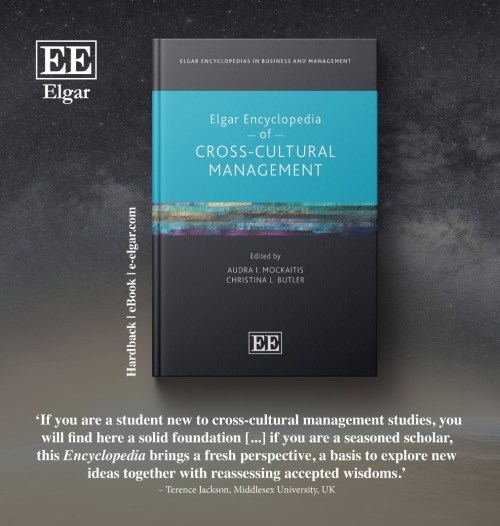
The Elgar Encyclopedia of Cross-Cultural Management is available now! Access the first chapter and introductory content for FREE here.
The Elgar Encyclopedia of Cross-Cultural Management, edited by Professor Audra I. Mockaitis (Maynooth University) and Professor Christina L. Butler (Kingston University), is the first reference book of its kind in the field. The book reflects the eclectic and interdisciplinary nature of cross-cultural management. It includes entries from scholars in cross-cultural psychology, business and management, anthropology, linguistics, sociology, and political science. These contributions form a collective discourse about the evolution and trajectory of the field. Authors present a range of perspectives, theories, and concepts. They challenge traditional paradigms. Together, they offer new multi-paradigmatic explanations to cross-cultural phenomena. Suitable for scholars, students and practitioners, the collection presents the state-of-the art in the cross-cultural management field.

Elgar Encyclopedia of Cross-Cultural Management Launching in October 2024
The presses are still hot as a new book is coming out in October, 2024. Edited by me and Professor Christina L. Butler from Kingston University, UK, the Elgar Encyclopedia of Cross-Cultural Management is the first reference book of its kind in the field.

The book reflects the eclectic and interdisciplinary nature of the field of cross-cultural management, with entries from scholars in the cross-cultural psychology, business and management, anthropology, linguistics, sociology, and political science disciplines, contributing to a collective discourse about the evolution and trajectory of the field. Authors present a range of perspectives, theories, and concepts, challenge traditional paradigms, and collectively offer new multi-paradigmatic explanations to cross-cultural phenomena.
Suitable for: scholars from various disciplines, as a guide to new developments in the field; students in any major that has a cross-cultural component to the curriculum (e.g., psychology, management, international business, sociology….) as a useful reference; and anyone with a curiosity about cross-cultural management.
The collection presents the state-of-the art in the cross-cultural management field. Written by eminent scholars from across the globe, entries include summaries, commentaries, and new perspectives on both theory and research. There are 78 chapters, or entries, in eight subject groups:
- Conceptualizations and Components of Culture
- Similarities and Differences across Cultures
- Interacting across Cultures
- Developing Cultural Awareness
- Cultural Identity and Diversity
- The Cross-Cultural Management of People
- Organizational and Institutional Perspectives
- Perspectives on Cross-Cultural Management
Available to purchase on the publisher’s website , AMAZON, Barnes & Noble, and other places!
ISBN: 978 1 80392 817 3
The Palgrave Handbook of Global Migration in International Business
I have recently published a new book.

The Palgrave Handbook of Global Migration in International Business (Audra I. Mockaitis, Ed.) presents novel research on various migration issues in the field of international business. The anthology contains 24 chapters, organized on five key themes representing perspectives and challenges borne by global migration within societies, firms, and individuals. Collectively, the authors examine global migration via the international business lens and present theoretical and practical solutions to a global grand challenge that is rapidly increasing in importance.
The five key themes of the book are:
Theme I: Migration Landscapes in International Business
Theme II: Navigating the Terrain of Language and Culture
Theme III: Leveraging and Managing Migration in the International Firm
Theme IV: Migrants as an International Business Resource
Theme V: The Migrant’s Journey
The book is written for a wide audience;. Researchers, scholars, international business professionals, policymakers, government organizations and NGOs working with migrants (refugees, skilled and unskilled immigrants) or migration issues, students and readers with a general interest in global migration-related topics will find something of interest in the book. The 59 authors are all experts in their fields and all conduct research on migration issues. Notably, while the authors reside in and represent various institutions in twelve countries, many of them are migrants themselves and have first-hand experience of many of the issues presented in the book.
See the Publisher page for more information and to download free sample chapters.
Interested in this book? Available to buy on:


The Book is available in Hardcover (ISBN : 978-3-031-38885-9), Softcover (ISBN: 978-3-031-38888-0) and eBook (ISBN: 978-3-031-38886-6).
VALUEHOST

An invitation to take part in a research study.
We are conducting a 3-year research study on Lithuanian values. We are interested in Lithuanians who have emigrated from Lithuania and are currently living in another country. We would like to learn whether living in another country shapes individuals’ personal values and in what ways. We are interested in the factors that shape our values. Importantly, do individual values change as a result of living in a new country? How long does this process take? Are the values of Lithuanians living abroad different from nonmigrant Lithuanians?
Have you emigrated from Lithuania?
Do you permanently live in any of the following countries?
✔ USA ✔ UK ✔ IRELAND ✔NORWAY ✔ GERMANY
Then we are interested in your experiences. Please click to take the survey.
This project is funded by the Lithuanian Research Council.
Read some of our previously published papers on migrant values.
Our paper on Lithuanian migrants and values has found a relationship between values and intentions to emigrate.
We have also analyzed the values of members of the Lithuanian diaspora. We found both similarities and differences in values between foreign-born Lithuanians and both Lithuanian emigrants and nonmigrant Lithuanians. Read the paper.
The Research Team:
Prof. Audra Mockaitis (PI), Prof. Vilmantė Kumpikaitė-Valiūnienė, KTU , Dr Vilmantė Liubinienė, Dr Jurga Duobienė, Dr Ineta Žičkutė, Irma Banevičienė

Migration Culture: A Comparative Perspective
Our new study on migration with a focus on countries that have a long or impactful history of migration has been published!
I am pleased to have collaborated with a group of authors of a new book, Migration Culture: A Comparative Perspective. We analyze the emergence of migration cultures at a societal level. Why are some societies more mobile and characterized by more deeply-rooted migration traditions than others? We suggest that environmental and institutional factors, and the evolution of societal-level values throughout certain periods in a country’s history, in combination, explain why migration in these societies becomes enmeshed with culture and in itself becomes a value.

More information about this publication can be found on the publisher’s website here.
Details:
Kumpikaite-Valiuniene, V., Liubiniene, V., Zickute, I., Duobiene, J., Mockaitis, A.I., & Mihi-Ramirez, A. (2021). Migration Culture: A Comparative Perspective. Cham, Switzerland: Springer.
ISBN 978-3-030-73013-0
ISBN 978-3-030-73014-7 (eBook)

Coping during the Pandemic: What a Difference a Generation Makes!
Audra I. Mockaitis (School of Business, Maynooth University)
Christina L. Butler (Kingston University Business School)

We present results from the first of a multi-part study that aims to gauge the extent that the COVID-19 pandemic has caused disruptions to people’s work-related and general wellbeing, and whether individuals with certain characteristics are better able to cope with these disruptions. We examine whether different generations are experiencing and dealing with effects of the COVID-19 pandemic differently.
In this note, we first discuss the changing nature of work before turning to highlight the generational challenges inherent in global leadership roles. We then present an overview of our research together with initial findings. We close with our thoughts on what these findings mean for organizations as they move forward into the “new normal”.
COVID has accelerated recent organizational changes
Over recent years, as organizations have tried to keep up with the rapid pace of technological change, they have been implementing flatter structures, more flexibility, and more participatory styles. Thus, pre-COVID, organizations were already emerging that are more fluid, and even boundaryless or borderless and are team- or networked-based [22] [18]. Telework and virtual participation were emerging too in tandem with these structural changes. The COVID-19 pandemic has thrust these shifts to the fore overnight for many other organizations around the globe. Owing to the pandemic, electronic forms of interaction at work have taken over as the only form for many and we expect them to remain the norm for the duration of the pandemic with long-lasting consequences for the future of work. For example, the UK Office for National Statistics is reporting that 44% of the labor force is working remotely during the pandemic, whereas in the same period in 2019 only 12% were doing so.
These changes to organizations and to the organization of work appear to bring many benefits to organizations. They can respond to crises or issues arising with little notice (such as the pandemic) and involving multiple locations, saving them time and costs, enhancing organizational innovation, creativity, diversity and social capital, and enabling them to quickly spread knowledge and access to key stakeholders across the globe, to name a few benefits [22].
However, flexibility is a double-edged sword. It is employees who implement and experience new ways of working. Individuals need to interact with and deal with multiple members across many different types of boundaries, focusing on their internal tasks, but also on maintaining and managing relationships with stakeholders around the globe. Increasing flexibility, although seen as beneficial to organizations, has potentially disruptive consequences for employees (e.g., longer working hours and an increase in crosscutting roles including across the home-work divide). Indeed, pre-COVID, the World Health Organization had declared stress as a 21st century health epidemic resulting in many chronic physical and mental diseases. It is important, though, to take a more nuanced approach to understanding the consequences that may vary by type of employee including the generation of which they are a part.
Pre-COVID, the generational makeup of the global workforce highlighted challenges for Millennials in management roles
As the Millennial generation – the largest generation in modern history to enter the workforce – is now moving into and up the ranks of middle management, it is key to understanding employees’ experiences of work under COVID [14] [17]. According to Hershatter and Epstein [8], Millennials crave stability, structure and clarity in the workplace, factors that are generated by centralized decision-making, well-defined responsibilities, and significant management oversight and that are found in traditional hierarchical organizations. Millennials also demand work–life balance – including flexible working hours and instant gratification – unlike work-centric Baby Boomers. These requirements have led to difficulties in retaining Millennials [1] [8] [14]. Apart from the possibility of increased flexibility offered by the sudden move to significantly more remote working under COVID, other Millennial work requirements may be harder to meet.
Given what we know about Millennials in the workplace, would Millennials find it more difficult to cope with isolation and work during the pandemic?
What our research shows
We received 422 responses to an online survey sent during the months of April and May, on work-related issues during the COVID-19 pandemic. After omitting invalid responses, our final sample was N=325, representing 41 countries, with 65.4% from Anglo countries and 34.6% from non-Anglo countries. 61% of respondents were female and 39% male, 76% were employed full-time, and all but 12% had a formal university qualification. In terms of age, the mean age of our sample was 45.9 years (min=20, max =74). We divided the sample into three groups to represent three distinct generations as follows: the Millennial generation (N=107) included people aged 24 to 40, Generation X (N=133) included ages from 41 to 55, and the Boomer generation (N=85) – from 56 to 74.
In the first part of this study, we included questions about one’s working life in general, as well as reactions to events over the previous week in terms of general wellbeing and stress. Support from Colleagues (α=.71) and Supervisor (α=.86), pertained to how often help and support, listening to problems and encouragement are offered by colleagues and supervisor. Oldenberg’s inventory [6] measured Burnout (α=.88). These constructs measured respondents’ situations pre-COVID.
The remaining constructs measured the extent of disruption caused during the pandemic. Three items gauged the extent to which respondents rated disruptions by COVID to their work, family and personal routines (α=.67). Vitality (α=.78) measured energy levels during the past week. General stress (α=.77) measured the extent of nervousness and negative mood, Cognitive stress (α=.77) measured difficulties in focus and concentration, and Wellbeing (α=.84) measured general feelings of good health, satisfaction and sense of purpose.

Table 1 presents the results of an ANOVA of differences in responses between generations prior to and during the pandemic. The greatest differences in coping during the COVID-19 pandemic are between the Millennial and Boomer generations. Specifically, Boomers report higher levels of vitality and wellbeing and lower levels of general and cognitive stress during the pandemic, as well as overall lower levels of burnout under usual circumstances. This is despite also reporting lower usual levels of supervisor support. Millennials report more or less the opposite. During the pandemic, Millennials experience significantly lower levels of vitality than other generations and significantly lower levels of wellbeing than Boomers. Despite usually perceiving significantly higher levels of supervisor support at work than Generation X, Millennials still experience high levels of burnout (significantly higher than Boomers). During the pandemic, Millennials report greater overall stress and cognitive stress (significantly higher than the other generation groups).
Why are there such stark differences among the generations? Why are the Millennials struggling more under COVID?
Butler, Zander, Mockaitis, and Sutton [4] suggest that global leaders who are successful in their roles have developed the necessary focus, drive and people-orientation [10] to confront changing organizational structures and the changing nature of work itself by practicing three interrelated roles: boundary spanner, blender and bridge maker. At the same time, these authors argue that Millennials from around the world may struggle comparatively more than other generations as they move toward or take up management positions. Our findings seem to reflect this analysis.
Organizational boundary spanners create and maintain strong linkages with the external environment to enable information and resources to flow across boundaries and to exert influence on stakeholders in achieving organizational objectives [13]. A desire for “quick” information and a focus on self may lead Millennials to struggle to present business needs in a sufficiently robust manner [5] to engage business audiences across a boundary-spanning environment [2][13][19] compared with other generations, especially when their own line managers are fully immersed in the current crisis and so less available to support direct reports.
Butler et al. [4] suggest that a blender role is important to achieve cultural fusion [12] among team members resulting in the group and the individual being equally, but differently, valued [9][11]. Despite being digital natives [16][20], narcissistic tendencies may interfere with a fully blended team experience for Millennials, especially when all work is conducted virtually, as can be the case during the pandemic, and when line managers are less available. This can lead to a negative impact on stress levels and well-being.
Lastly, successful bridge makers engage readily with the ‘cultural other’ while ensuring successful interaction among people across different national cultural boundaries [15]. DiStefano and Maznevski [7] emphasize the importance of being able to decenter, a challenge for Millennials who are comparatively self-focused. A highly virtual work environment exacerbates the lack of interest in others and increases a focus on self [21], interfering with the ability to see others’ perspectives.
It is thus paradoxical that Millennials, who are characterized by being technologically savvy, are having the hardest time coping with the pandemic. All of our respondents reported similar degrees of disruption to their lives as a result of COVID. Members of other generations appear to be getting on with their lives better than Millennials, despite having relatively more responsibility (e.g., balancing work and family or supervisory roles). They report higher levels of wellbeing and less stress. However, our research suggests that in comparison to other generations, Millennials may need more attention from supervisors (in the form of support and encouragement), who are less available now. Organizations need to respond to this leadership paradox now to move successfully from COVID to the “new normal”.
You can read a more detailed report from this study here.
Please cite this paper as:
Mockaitis, A.I. & Butler, C.L. (2023). Disrupted: remote work and life under lockdown during the great COVID-19 pause. MUSSI Working Paper No 17. MUSSI, Maynooth, Ireland.
References
- Anderson, H.J., Baur, J.E., Griffith, J.A., and Buckley, M.R. (2017), ‘What works for you may not work for (Gen) Me: Limitations of present leadership theories for the new generation’, Leadership Quarterly, 28(1): 245–60.
- Barner-Rasmussen, W., Ehrnrooth, M., Koveshnikov, A., and Mäkelä, K. (2014), ‘Cultural and language skills as resources for boundary spanning within the MNC’, Journal of International Business Studies, 45(7): 886–905.
- Butler, C.L., Sutton, C., Mockaitis, A.I. and Zander, L. (2020), ‘The new millennial global leaders: what a difference a generation makes!’ In: Zander, Lena, (ed.) Research handbook of global leadership: making a difference. Cheltenham, U.K.: Edward Elgar Publishing Limited. pp. 141-163.
- Butler, C.L., Zander, L., Mockaitis, A.I., and Sutton, C. (2012), ‘The global leader as boundary spanner, bridge maker, and blender’, Industrial and Organizational Psychology: Perspectives on Science and Practice, 5: 246–9.
- Carr, N. (2008), The Big Switch: Rewiring the World, from Edison to Google. New York: Norton.
- Demerouti, E., Mostert, K., and Bakker, A.B. (2010), ‘Burnout and work engagement: A thorough investigation of the independency of both constructs’, Journal of Occupational Health Psychology, 15 (3): 209-222.
- DiStefano, J.J., and Maznevski, M.L. (2000), ‘Creating value with diverse teams in global management’, Organizational Dynamics, 29(1), 45–63.
- Hershatter A. and Epstein, M. (2010), ‘Millennials and the world of work: An organization and management perspective’, Journal of Business Psychology, 25: 211–23.
- Hewstone, M. and Brown, R. (1986), ‘Contact is not enough: An intergroup perspective’. In M. Hewstone, and R. Brown (Eds), Contact and Conflict in Intergroup Encounters. Oxford: Blackwell, 1–44.
- Holt, K. and Seki, K. (2012), ‘Global leadership: A developmental shift for everyone’, Industrial and Organizational Psychology: Perspectives on Science and Practice, 5(2): 196–215.
- Hornsey, M. and Hogg, M. (2000), ‘Assimilation and diversity: An integrative model of subgroup relations’, Personality and Social Psychology Review, 4: 143–56.
- Janssens, M. and Brett, J.M. (2006), ‘Cultural intelligence in global teams: A fusion model of collaboration’, Group and Organization Management, 31(1): 124–53.
- Johnson, K.L. and Duxbury, L. (2010), ‘The view from the field: A case study of the expatriate boundary-spanning role’, Journal of World Business, 45: 29–40.
- Kwoh, K.L. (2012), ‘More firms bow to generation Y’s demands’, Wall Street Journal, 22 August: B6.
- Levy, O., Lee, H.J., Jonsen, K., and Peiperl, M.A. (2019), ‘Transcultural brokerage: The role of cosmopolitans in bridging structural and cultural holes’, Journal of Management, 45(2): 417–50.
- Palfrey, J. and Gasser, U. (2008), Born Digital: Understanding the First Generation of Digital Natives. Philadelphia, PA: Basic Books.
- Pew Research Center (2018), ‘Millennials surpass Gen Xers as the largest generation in US labor force’, at www.pewresearch.org (accessed 10 July 2019).
- Simões, V.C., Da Rocha, A., De Mello, R.C., and Carneiro, J. (2015), ‘Black swans or an emerging type of firm? The case of borderless firms’, The Future of Global Organizing: Progress in International Business Research, Vol. 10: 179-200.
- Small, G. and Vorgan, G. (2008), iBrain: Surviving the Technological Alteration of the Modern Mind. New York: Harper Collins.
- Tapscott, D. (2009), Grown Up Digital. New York: McGraw Hill.
- Weber, J. (2017), ‘Discovering the Millennials’ personal values orientation: A comparison to two managerial populations’, Journal of Business Ethics, 143(3), 517–29.
- Zander, L., Butler, C.L., Mockaitis, A.I., Herbert, K., Lauring, J., Mäkelä, K., Paunova, M., Umans, T. and Zettinig, P. (2015), ‘Team-based global organizations: the future of global organizing’, In: Van Tulder, R., Verbeke, A. and Drogendijk, R., (eds.) The future of global organizing. Emerald Group Publishing Limited. pp. 227-243. (Progress in International Business Research).
 Professor Audra I. Mockaitis