
Home » Uncategorized (Page 2)
Category Archives: Uncategorized
A Portrait of Lithuanian Societal Values

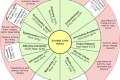
Notes: ESS = European Social Survey; Hof = Hofstede cultural dimensions; SVS = Schwartz Values Survey; WHR = World Happiness Report; WVS = World Values Survey.
The values emphasized by a society are central to understanding its culture; they lie at the very heart of culture and shape the society’s beliefs, understanding, practices, norms and institutions (Schwartz, 2006). To me culture is a set of learned and shared values that influences our way of life, our perceptions, beliefs and attitudes, and distinguishes one human group from another (Mockaitis, 2002).
The figure above represents a glimpse into Lithuanian culture, based on an analysis of large-scale studies of values to date that have included Lithuania. There are five such studies that have ranked countries based on values or combinations of values at the societal level:
- A study in 50 societies conducted by Ralston et al. (2011) based on the Schwartz Values Study (SVS).
- A study on Lithuanian national cultural values conducted by Mockaitis (2002) that compares Lithuania to 69 other countries in Hofstede’s database.
- The World Values (WVS) by Inglehart et al. (2014) that provides access to a 70-country database.
- The World Happiness Report (WHR) by Helliwell et al. (2018) of 156 countries.
- The European Social Survey (2016) (ESS) comparing values in 23 European societies.
These studies enable us to discuss Lithuanian values relative to those of other countries/cultures albeit not in absolute terms. The focus is on the dimensions of values in the main circle. The larger the slice of the circle, the more emphasis is placed on the values comprising that dimension by Lithuanians. The outer layer depicts the types of values that comprise each of the dimensions, with additional supporting evidence about Lithuania’s ranking on related single-item values from other studies. In depicting the cultural orientations, I have followed the structure of Schwartz (2006); the cultural value orientations are displayed based on shared assumptions between them. Adjacent orientations share assumptions and are compatible. Incompatible orientations or those with opposing assumptions lie on opposite sides of the circle. A brief explanation of the orientations/dimensions follows.
Schwartz’s (2006) first dimension is labelled autonomy vs embeddedness. This is conceptually similar to individualism vs collectivism, and thus the orientation affective autonomy and individualism are adjacent, while embeddedness is opposite. In individualistic cultures people place emphasis on the self over the group and are encouraged to express their own ideas, speak their mind and rely on oneself. Affective autonomy encourages individuals to pursue personal gratification, pleasure, excitement and variety in life. We see that Lithuania is a mildly individualistic society (ranking 28th out of 70 countries) and quite low on affective autonomy. Lithuanians value independence and self-reliance to a moderate degree but not personal fulfilment and personal enjoyment. This is supported by Lithuania’s low ranking in the ESS at 19th of 23 countries. In affective autonomy Lithuania is similar to India, Chile, Lebanon and Thailand.
However, Lithuania scores rather high on the opposing orientation Embeddedness. Embedded cultures believe that people are interwoven within the wider collective. Relationships are important as a means for attaining shared goals and maintaining a shared identity. Restraining from actions that might disrupt the societal order, stability and security is the norm, as is respect for tradition and the status quo. In the WHR and WVS, Lithuania ranks rather low on the belief that people are able to make their own life choices. People are bound by or embedded within the wider group or society. Lithuania’s embeddedness orientation is similar to that of Singapore, Finland, Turkey, Hong Kong and Malaysia.
Related to this is the uncertainty avoidance dimension of Hofstede (1980a). This dimension depicts “the extent to which the members of a culture feel threatened by uncertain or unknown situations (Hofstede, 1991: 113)” and their ways of coping with uncertainty. In societies higher on this dimension we find lower tolerance of change, more coping mechanisms such as rules, procedures, control and details, higher stress, emotions and anxiety, and a lower acceptance of outsiders. Lithuania ranks medium high on this dimension, similar to Germany, Equador, Thailand and Morocco. Easy going or laid back would not be fitting adjectives for describing Lithuanians.
How concerned are Lithuanians with the welfare of others? The value orientation egalitarianism underscores concern for other people’s welfare, recognizing them as equals, and an expectation to act for the benefit of others (Schwartz, 2006). Values held by egalitarian cultures are equality, honesty, social justice, being helpful and dependable. Lithuanian’s ranking is not high (35th of 50 countries), on par with countries such as China, India, South Korea, Hong Kong and Vietnam. Supporting evidence from the ESS shows that compared to other European countries, Lithuanians strongly believe that men have more rights to a job than women, and strongly disbelieve that all people should be treated fairly and that people should care about the wellbeing of others (ranking last out of 23 European countries).
In the WVS Lithuania scores high on survival values and low on self-expression values. Inglehart and Welzel’s (2005) survival vs. self-expression values were conceptually refined by Welzel (2013) to produce the emancipative values index. Emancipative values are akin to human empowerment and place priority on gender equality, equal opportunities, freedom of choice, personal autonomy and self-expression, acceptance of homosexuality, abortion and divorce. Lithuania scores rather low on emancipative values. According to Welzel (2013), emancipative values strengthen with rising levels of education and resources such as wealth and intellectual skills. Opportunities to connect with others also induce these values. As emancipative values spread through society, people also become less preoccupied with material security and shift their focus to happiness and life satisfaction (Bates, 2014). As Lithuania’s position on mastery and material wealth shows, this is not yet the case; Lithuanians are also relatively unhappy, ranking 50th (of 156 countries) on the WHR and 22nd (of 23 countries) on the ESS.
In the WVS Lithuania scores high on secular-rational values and low on traditional values. This dimension was further refined by Welzel (2013) into the secular values index. Lithuania scores intermediate on secular values (ranking 22nd out of 71 countries), placing relatively low priority on authority, including religious authority (faith, commitment, religious practice), patrimonial authority (the nation, the state and parents), authoritative institutions, such as the army, police and the justice system, and normative authority (anti-bribery, anti-cheating and anti-evasion norms). In fact, in perceptions of corruption, Lithuania ranks 4th of 156 countries in the WHR by Helliwell et al. (2018).
In the figure adjacent to secular values and opposite egalitarianism we find power distance. This dimension from Hofstede (1980a, 2001) reflects the extent to which less powerful people within a society accept the fact that power is distributed unequally within the society, institutions and organizations. With an index score of 45 and a ranking of 51 out of 70 countries, Lithuania is in the medium range on power distance, as are countries such as Hungary, Jamaica, USA and Estonia. In certain contexts displays of authority, status, power, prestige and inequality will be acceptable, in others less so, although the values associated with uncertainty avoidance, low egalitarianism and embeddedness may connote that power and inequality are part of the fabric of order in society and people are socialized to accept the rules and obligations embedded within the hierarchical structure. As such there may be little outward resistance despite a lower internal tolerance or preference for power distance.
On opposing poles in the figure we see harmony and mastery. Lithuania ranks high on mastery and lower on harmony. The lower ranking on harmony is associated with a lower importance on and appreciation for the natural environment (India, Portugal, Taiwan and Russia rank similarly). Mastery embodies values such as self-assertion, recognition, success and competence, control over the environment or changing it for the purpose of attaining one’s own goals (Schwartz, 2006). Next to mastery is the masculinity dimension of Hofstede (1980a), which pertains to the “extent to which the dominant values in society are ‘masculine’” (Hofstede, 1980b: 46); masculine values are those such as assertiveness, the attainment of wealth, money and things, ambition and success. On the opposing pole are feminine values, such as nurturing, cooperation, relationships, friendliness, quality of life and harmony. Lithuania ranks high on masculinity (14th out of 70 countries, similar to China, Philippines, Colombia and Poland) and high on mastery (ranked 12th of 50 countries, near Bulgaria, Portugal, Turkey and Russia). ESS results support Lithuania’s high ranking on mastery and masculinity; out of 23 European countries Lithuania ranks first in the importance placed on material wealth and fourth in the extent to which success is valued. With respect to caring for the environment and preserving nature (harmony), Lithuania ranks 21st of the 23 European countries on the ESS.
References
Bates, W. (2014). Where are emancipative values taking us? Policy, 30 (2): 12-21.
European Social Survey (2016). ESS8-2016 Documentation Report. Edition 2.0. Bergen, European Social Survey Data Archive, NSD – Norwegian Centre for Research Data for ESS ERIC.
Helliwell, J.F., Layard, R., & Sachs, J.D. (2018). World Happiness Report 2018. New York: Sustainable Development Solutions Network.
Hofstede, G. (1980a). Culture’s Consequences. International Differences in Work-Related Values. Beverly Hills, CA: Sage.
Hofstede, G. (1980b). Motivation, leadership, and organization: Do American theories apply abroad? Organizational Dynamics, 9: 42-63.
Hofstede, G. (1991). Cultures and Organizations: Software of the Mind. New York, New York: McGraw-Hill.
Hofstede, G. (2001). Culture’s Consequences: Comparing Values, Behaviors, Institutions and Organizations across Nations. Thousand Oaks, CA: Sage.
Inglehart, R., C. Haerpfer, A. Moreno, C. Welzel, K. Kizilova, J. Diez-Medrano, M. Lagos, P. Norris, E. Ponarin & B. Puranen et al. (eds.) (2014). World Values Survey: Round Three – Country-Pooled Datafile Version: www.worldvaluessurvey.org/WVSDocumentationWV3.jsp. Madrid: JD Systems Institute.
Inglehart, R. & Welzel, C. (2005). Modernization, Cultural Change, and Democracy. Cambridge: Cambridge University Press.
Mockaitis, A.I. (2002). The influence of national cultural values on management attitudes: A comparative study across three countries. Unpublished doctoral dissertation, Vilnius University.
Ralston, D.A., Egri, C.P., Mockaitis, A.I., et al. (2011). A twenty-first century assessment of values across the global workforce. Journal of Business Ethics, 104: 1-31.
Schwartz, S. H. (2006). A theory of cultural value orientations: Explication and applications. Comparative Sociology, 5 (2-3): 137-182.
Welzel, C. (2013). Freedom Rising: Human Empowerment and the Quest for Emancipation. New York: Cambridge University Press.
World Values Survey. http://www.worldvaluessurvey.org
Lithuanians are leaving their country in droves but the government panders to expatriate elites

A 2018 OECD report has found that net migration for Lithuania will remain negative for at least the next few decades. This is worrying in a country that is already the European leader in emigration rates[1]. Lithuania has been labelled by some authors as possessing a “culture of migration”[2]. By 2030 it is estimated that the working-age population will decrease by 30%[3]. Yet the Lithuanian government invests millions in programs focused on the Lithuanian diaspora, long-settled communities of Lithuanians abroad, mostly comprised of people with little intention of returning, as well as “elite” emigrants, who are mostly either highly educated and/or skilled professionals.
The government depends on non-representative surveys of these elites to inform policy, and has spent almost 19 million euros over the last six years on its “Global Lithuania” program[4]. According to the Ministry of Foreign Affairs website[5], the two key goals of the Global Lithuania program are to strengthen ties with specific individuals, who have been recognized in their countries as leaders in their professions (in other words, a select few elites), and to strengthen ties with established official Lithuanian organizations abroad (in other words, diaspora organizations that do not attract recent emigrants and whose members have little intention of “returning” to Lithuania). It also maintains a Facebook page that has just under 13,000 followers (out of 1.3 million emigrants). Thus, 19 million euros have been dedicated to a handful of individuals to pursue special interests, instead of directly addressing the migration crisis in Lithuania. In addition, the Lithuanian parliament has dedicated 2019 as a year for world Lithuanians; thus we may expect to see more funding targeted at these elite groups.
Meanwhile, within Lithuania’s borders we see a dramatic brain drain, a decrease in numbers of university graduates by almost half over an 8 year period to 2015 to only 13,000 university graduates, few and ineffective initiatives to attract non-elite emigrants back home (a government-sponsored repatriation website http://renkuosilietuva.lt/ received only 400 official queries in two years[6]), and a marked inability of returnees to find suitable employment. Although the unemployment rate in 2017 was 7%[7], only 31.5% of repatriates found work within 12 months of return (2015 data), as many local employers prefer not to hire those with international experience[8]. This mass emigration and decline in working-age population, an outward focus by the government on emigrant elites and diaspora organizations, and a reluctance by local firms (and lack of incentives) to hire repatriates are disconcerting and puzzling.
References
[1] Eurostat (2007). Statistical office of the European Union Eurostat.
[2] Kumpickaitė-Valiūnienė, V., & Žičkutė, I. (2017). Emigration after the socialist regime in Lithuania: Why the west is still the best. Baltic Journal of Management, 12 (1): 86-110.
[3] OECD (2018). OECD Reviews of Labour Market and Social Policies: Lithuania. OECD Publishing, Paris.
[5] http://www.urm.lt/default/lt/globali-lietuva
[6] OECD (2018).
[7] https://data.worldbank.org/indicator/SL.UEM.TOTL.ZS
[8] OECD (2018).
A statistical fairytale
I recently needed to estimate my sample size for a survey. To come up with my magic number I first needed to know the population size, and so I began to search for official data. In this case I was interested in the Lithuanian diaspora population. In my search I came across some surprising data published by Lithuanian government institutions that left me scratching my head and wondering how it was possible to come up with such strange numbers. And so my story begins…
A tale of two websites
Since Lithuanian independence in 1990, the population has decreased by 845,000. In 1990 Lithuania’s population was 3.7 million; in 2017 it was 2.8 million, a decrease of 23% (EMN, 2017[1]).
According to the website “Migration in Numbers” by the European Migration Network (EMN) (http://123.emn.lt/), which presents statistics compiled via collaboration between six institutions[2], during the past seven years (2010-2016), there were 348,425 emigrants from Lithuania. The highest numbers have emigrated to the UK (164081), Ireland (35911) and Norway (24331) among others.
However, data published by the Lithuanian Department of Statistics (LDS) paint a different picture. In its 2014 publication “Lietuviai pasaulyje” (Lithuanians in the World), the LDS claims to have collected data over a 10 year period (2005-2014) from official census data in different countries on the numbers of permanent resident Lithuanians in those countries. Lithuanians were defined as people who: are Lithuanian citizens, and/or were born in Lithuania, and/or are of Lithuanian heritage, and/or whose native language is Lithuanian.
That’s a lot of and/ors. According to the LDS definition, non-Lithuanian citizens are not excluded from this list. This means that they counted anyone who identifies with Lithuania whether or not they were born in Lithuania and whether or not they speak Lithuanian as their native language. A candidate for this list might be someone who is of Lithuanian descent but does not speak the language. Another candidate might be someone who was born in Lithuania and is a Lithuanian citizen. Yet another candidate might be a non-Lithuanian citizen, whose native language is Lithuanian (such as a second generation foreign born national). Given such a wide net, we would expect the Lithuanian diaspora population to be extremely large. Yet, according to the LDS data, this is not the case. Take a look at these numbers. I have included just a sample of countries with larger Lithuanian populations:
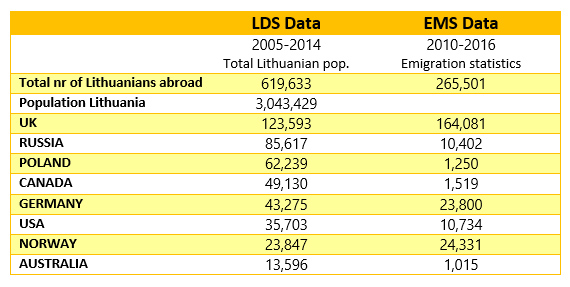
Something doesn’t add up, right? The first line alone already tells a puzzling tale. It tells us that emigrants from Lithuania during the years 2010 to 2014 comprised more than a third (35%) of all Lithuanians living abroad[3]. Really? In five years?
If we look at the data for the UK, in 2014 the LDS claims there were 123,593 broadly defined Lithuanians in the UK. EMS statistics show that 164,081 emigrants left Lithuania for the UK from 2010 to 2016. If we use 2014 as a cutoff for the LDS statistics, that leaves a difference of 40,488. In fact, 42265 Lithuanians did leave for the UK during 2015 and 2016, so these numbers are pretty close. However, the LDS data do not refer only to recent immigrants to the UK, but to the total numbers of Lithuanians residing in the country – anyone with a Lithuanian passport, anyone who speaks Lithuanian, and anyone who considers oneself to be Lithuanian. Shouldn’t there be more?
Let’s consider the USA example. Here the EMS data indicate only 35,703 Lithuanians in the USA, a number that is baffling. Just under 11,000 Lithuanians immigrated to the USA during the past seven years. Even if we remove the 2,366 people that moved there in the last two years, this means that Lithuanian immigrants have contributed to a rise in the US-Lithuanian population of around 30% from 2009-2014 (5 years) alone.
Let’s consider the statistics from the USA census data (the data that the LDS claim to have relied on). The 2000 US census data has the Lithuanian-American population at 659,992. Sure, not all of these hundreds of thousands speak Lithuanian, or hold a Lithuanian passport, but it is quite probable that, if they are included in the US census data, they identify as Lithuanian or are of Lithuanian heritage. So how has the LDS overlooked this in its calculation of Lithuanian residents in the USA – an eighteen fold difference?

Did the LDS not check sources? Did they really receive census data that counters available published census data? Was there no cross-checking?
I have not found many additional published sources on the diaspora population. If a reliable recent source exists, I would be grateful to learn about it.
Notes.
[1] http://123.emn.lt/#emigracija
[2] Ministry of the Interior, Statistics Lithuania, Migration department, Lithuanian Labour Exchange, European Migration Network (EMN), International Organization for Migration (IOM) Vilnius Office.
[3] From 2010 to 2014 there were 218952 total emigrants from Lithuania (EMS data).
Picture source: www.bluemailmedia.com
 Professor Audra I. Mockaitis