
Home » Posts tagged 'Culture'
Tag Archives: Culture
Diaspora & Cultural Identity
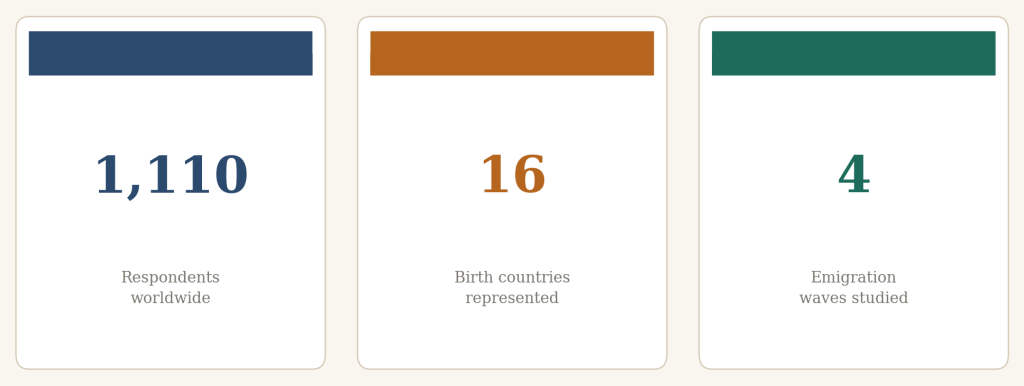
I surveyed over 1,100 Lithuanian migrants worldwide expecting to find cultures drifting apart across generations. What we found was more surprising.
The story we usually tell about diaspora goes something like this: a people displaced from their homeland carry its culture with them, transmit it to their children, and over generations it slowly fades as they assimilate into their host countries. The Lithuanian diaspora, consisting of waves of wartime refugees, Soviet-era exiles, and more recent economic migrants scattered across continents, seemed to be the perfect setting for testing that story. It turned out to complicate it considerably.
What we found
We measured individual-level cultural values across five dimensions: collectivism, uncertainty avoidance, power distance, masculinity, and long-term orientation, comparing Lithuanian-born migrants, foreign-born diaspora members, and nonemigrant home country nationals.
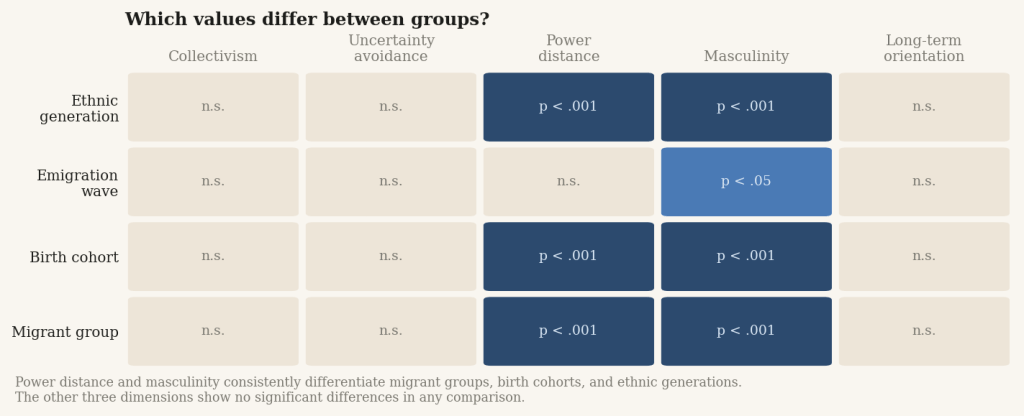
On three of the five dimensions, the groups were strikingly similar. Collectivism, uncertainty avoidance, and long-term orientation showed no significant differences across generations, emigration waves, or migrant groups. Values that one might expect to erode over decades of living abroad appear, instead, to hold.
Three of five cultural values showed no significant differences between migrants and nonemigrants, regardless of how long ago, or from where, people left.
The differences that did emerge were on power distance and masculinity. Lithuanian-born migrants score higher on both than foreign-born diaspora members, and the generational pattern is clear: older cohorts, who came of age under Soviet rule or post-independence economic turbulence, endorse hierarchy and assertiveness more strongly than younger cohorts socialized in more open, prosperous conditions. This is consistent with what we know about values formation: people carry the imprint of the world they grew up in.
The bigger question
Perhaps the most counterintuitive finding is about timing. We might expect post-war diaspora members, who have been separated from Lithuania for decades, unable to return, to have drifted furthest from home country values. They have not, at least not on most dimensions. The differences between emigration waves are modest. What appears to matter more than when people left is the simple fact that they left at all: migrants as a group differ from nonemigrants in consistent ways, regardless of wave or generation.
This has implications well beyond the Lithuanian case. International business research routinely treats national culture scores as if they describe a homogeneous group. Behind any national average lie subgroups shaped by radically different histories – people who fled, people who chose to go, people born abroad to parents who fled. Collapsing those distinctions into a single number discards exactly the variation that tells us something interesting about how culture actually works.
See:
Mockaitis, A.I., & Zander, L. (2023). Dissecting generations of migrant identities within a diaspora. In: A.I.Mockaitis (Ed.). The Palgrave Handbook of Global Migration in International Business, Palgrave Macmillan, Cham. https://doi.org/10.1007/978-3-031-38886-6_6
Eggstraordinary Art: A New Book Just Released on Egg Decorating
Once a year for at least a week, my kitchen and dining room become a frenzied artist’s workshop full of dyes, the smell of melting beeswax, and a variety of tools. I go on a hunt for white chicken eggs to ethnic shops (and chicken farms!) and buy as many as I can, and spend my days hunched over the delicate eggs, painstakingly fashioning each egg into a work of art. Each year I try a new technique or style, searching for design inspirations that surpass the creations of the year before. Some of the eggs take several hours, depending on the tradition in which they are designed. Decorating eggs this way for Easter is a family and ethnic tradition. I have been decorating since childhood, and over the years I have amassed a collection of my favorite ones. Many of the eggs are given as gifts. For the past decade, I have taken photos of them and shared them with the Lithuanian community.
These photos are now published in my new book Eggstraordinary Art: Beautiful Eastern European Eggs for Easter. It is available now worldwide on Amazon.

Click here to go to the sales website.

The eggs in this photo are decorated in traditional Lithuanian style using the drop-pull method. But I have also learned the Ukrainian method, which is far more intricate. The book includes descriptions of these traditions and a photo gallery.

Understanding Openness to Change among Lithuanian Generations
VALUEHOST is a three-year research project funded by the Lithuanian Research Council. We explore changing Lithuanian values, with a focus on emigrants and their experiences in their host countries. In this post, I introduce some interesting findings from one of our studies on changing values at home.
We have analyzed data between the years 2010-2020, from the European Social Survey database on individuals’ values. In this study, we were interested in exploring whether values can change in the short term. Scholars have long held that values are enduring, and that they are very slow to change. In societies, this change would be steady, and progressive over generations. Typically, we notice these differences by comparing our own values with those of our parents’ generation.
But much of the research on values change has been in the context of relatively stable advanced economies. Generations here have labels which we all know: Baby Boomers, Gen X, Gen Y, etc. Societies in the former USSR, though, have had different social, political, and economic transformations. Their process of modernization has been quite different.
In our study, we distinguish between generations which we link to political eras. People who grew up in these different eras in Lithuania acquired their values during vastly different historical periods. Some periods were more turbulent than others. We label them the Stalin generation for individuals born before 1945. The Soviet generation includes those born between 1945 and 1969. The late Soviet generation comprises those born from 1970 to 1989. The Independent EU generation includes individuals born after 1989. One of our aims was to compare the values of these different political generations to one another and over time.
Here we look at one of the results on Openness to Change values, derived from the work of Shalom Schwartz. This is a measure that combines three personal values: self-direction, stimulation and hedonism. Self-direction encompasses the extent to which individuals value independence in thought and action. Stimulation reflects how much people value excitement, novelty and challenges in life. And hedonism refers to the pursuit of personal pleasure or immediate gratification.
We compared six rounds of surveys across more than 11,000 individuals, starting in 2010, and every two years thereafter.

In the figure, we can see that openness to change appears to fluctuate over the years. Some generations are quite similar, but one stands out – the Independent EU generation. These are individuals, who, at the time of the survey, were between the ages of 18 and 30. For the other generations, openness to change declines slightly but increases over time by survey round 10 in 2020. We see the opposite in the youngest generation. Here, openness to change declines steadily over the years. In the final survey round, there is a slight increase. But overall, openness to change has declined for this generation during the 10 years up to 2020.
We would be interested in hearing your thoughts about why this has happened.
Explore the Elgar Encyclopedia of Cross-Cultural Management
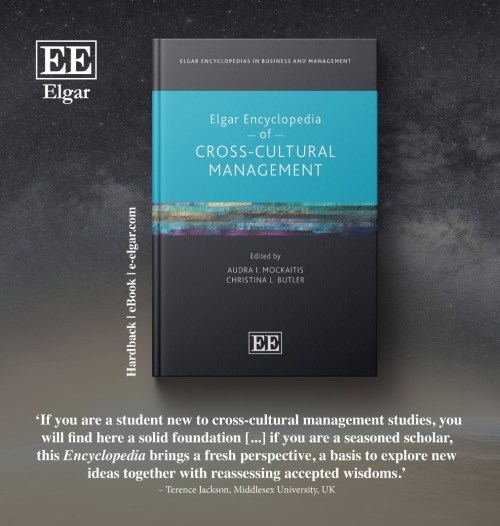
The Elgar Encyclopedia of Cross-Cultural Management is available now! Access the first chapter and introductory content for FREE here.
The Elgar Encyclopedia of Cross-Cultural Management, edited by Professor Audra I. Mockaitis (Maynooth University) and Professor Christina L. Butler (Kingston University), is the first reference book of its kind in the field. The book reflects the eclectic and interdisciplinary nature of cross-cultural management. It includes entries from scholars in cross-cultural psychology, business and management, anthropology, linguistics, sociology, and political science. These contributions form a collective discourse about the evolution and trajectory of the field. Authors present a range of perspectives, theories, and concepts. They challenge traditional paradigms. Together, they offer new multi-paradigmatic explanations to cross-cultural phenomena. Suitable for scholars, students and practitioners, the collection presents the state-of-the art in the cross-cultural management field.

Elgar Encyclopedia of Cross-Cultural Management Launching in October 2024
The presses are still hot as a new book is coming out in October, 2024. Edited by me and Professor Christina L. Butler from Kingston University, UK, the Elgar Encyclopedia of Cross-Cultural Management is the first reference book of its kind in the field.

The book reflects the eclectic and interdisciplinary nature of the field of cross-cultural management, with entries from scholars in the cross-cultural psychology, business and management, anthropology, linguistics, sociology, and political science disciplines, contributing to a collective discourse about the evolution and trajectory of the field. Authors present a range of perspectives, theories, and concepts, challenge traditional paradigms, and collectively offer new multi-paradigmatic explanations to cross-cultural phenomena.
Suitable for: scholars from various disciplines, as a guide to new developments in the field; students in any major that has a cross-cultural component to the curriculum (e.g., psychology, management, international business, sociology….) as a useful reference; and anyone with a curiosity about cross-cultural management.
The collection presents the state-of-the art in the cross-cultural management field. Written by eminent scholars from across the globe, entries include summaries, commentaries, and new perspectives on both theory and research. There are 78 chapters, or entries, in eight subject groups:
- Conceptualizations and Components of Culture
- Similarities and Differences across Cultures
- Interacting across Cultures
- Developing Cultural Awareness
- Cultural Identity and Diversity
- The Cross-Cultural Management of People
- Organizational and Institutional Perspectives
- Perspectives on Cross-Cultural Management
Available to purchase on the publisher’s website , AMAZON, Barnes & Noble, and other places!
ISBN: 978 1 80392 817 3
On Language, Culture and Bilingualism
 I have had the fortune of teaching cross-cultural management in international business courses in a university context for two decades. As a native of the USA, I was raised speaking two languages – Lithuanian and English, in two relatively separate language communities, and studied several other languages in my youth and adulthood. The topics of language and culture are of great interest and relevance to me, and this interest has only increased after having my daughter, whom I raise as a bicultural bilingual.
Code-switching is the process of switching between two languages with relative ease, usually within a single conversation, or sentence. I have done this all of my life with my Lithuanian-American bilingual friends, and continue to do so with native English speakers of Lithuanian heritage in Australia (and I admit that I even do so with my daughter). It is a natural process that sometimes occurs instinctively, and always depends on to whom I am speaking, but I am always fully aware that I am doing it. For someone who is not fully bilingual in the two languages, code-switching may give the impression that the speakers are more comfortable with one or the other language, but this is not always the case. I am equally comfortable with speaking the two languages, however, the reason for doing so often lies in the context (for example whether or not there is a shared context with the speaker, or whether there is an unconscious desire to try to establish such shared meaning).
Cultural code-switching also occurs, when individuals change their behaviors in accordance with the norms of another culture. Although it depends on situational factors, the extent of disparity between cultures, familiarity with cultural norms and cultural values, psychological comfort and other factors [1], switching between cultures is common for individuals who are raised as biculturals. Our cultural values only fully take shape in our later adolescent and early adulthood years, yet children have a sense about cultural norms already from an early age.
As a community language school principal, I have been able to observe children’s behaviors in different situations. As one example, bilingual children may address Lithuanian-speaking adults and English-speaking adults (and children) in different ways, such as with formal forms of address despite insistence from some adults that they use informal forms – first names [2]. Although this is solely anecdotal, as it is not possible for me to actually measure the children’s comprehension of cultural norms, it has led me to think about some of the factors that affect bilingualism and the relationship between culture and language in bilingual families.
The relationship between language and culture is undisputed in the literature. I hold a strong view that language is a primary mechanism for transferring cultural values and norms. We can certainly learn (about) another culture, but without knowledge of the language, I do not think it is possible to fully understand cultural context, nuance and norms of behavior. The more fluency a child has in a language, the easier the transfer of the culture associated with the language will be. Is it possible for a person to be bilingual but not bicultural? Yes.
Active bilinguals use the two languages regularly in their everyday lives [3]. There are varying degrees of bilingualism. Passive bilingualism or receptive bilingualism means that a person does not actively use the second language, but may understand it. This can occur in children who begin speaking a language at home, but then gradually (or suddenly) refuse to speak it as they gain more exposure to the mainstream language. There are many reasons as to why this may occur, however, this does not mean that the language is lost, although some scholars do claim that passive bilinguals are at risk of losing the language. Children may hear the language at home but not produce it themselves; these children are less likely to speak the language to their own children, while active bilingual children from mixed language families are more likely to establish friendships with other active bilinguals and preserve the language themselves [4].
Scholars have empirically found that consistency in language use by parents is key to language acquisition and retention – it depends on parental effort and motivation. Children who seldom hear the language or whose parents do not use it at home will not use the language actively [5]. This is often difficult in households where only one parent speaks the minority language, because the child is aware that she or he can revert to the dominant language. Parents often lament that their child has decided not to speak the language, and thus they themselves revert to speaking English in the home. However, even if the language is not actively used by a child, consistent exposure (e.g., parental effort) to it ensures that it is retained and can be revived when the child is motivated to use the language [6].
Language and culture are transferred through socialization – from parent to child, within the language community, via consistent exposure. It is thus up to the parent – not the child – to preserve them. Children do not make informed decisions about language and culture use. But their linguistic and cultural environments are determined and shaped by the values, attitudes, beliefs (and behaviors) of the people who make up their environment.
Thus, do not worry about code-switching, mixing languages, accents or even total fluency in the language. The important thing to focus on by parents is to ensure that the child hears the language in a consistent manner on a regular basis.
Click here for some insight and advice about bilingualism in children by renowned psycholinguist François Grosjean.
References
[1] Molinsky, A. (2007). Cultural code-switching: The psychological challenges of adapting behavior in foreign cultural interactions. The Academy of Management Review, 32 (2): 622-640.
[2] In fact, in a cross-national study on forms of address, Lithuanian adults indicated the lowest preference among 22 countries for using first names to address someone in an authority position. See: Harzing, A.W., Mockaitis, A.I. et al. (2010). What’s in a Name? Cross Country Differences in Preferred Ways of Address for University Teachers. AIB Insights, 10 (3): 3-8.
[3] Grosjean, F. (2001). Life with Two Languages: An Introduction to Bilingualism. Cambridge: Harvard University Press.
[4] De Houwer, A. (1999). Environmental factors in early bilingual development: the role of parental beliefs and attitudes.In G. Extra & L.Verhoeven, eds., Bilingualism and Migration. Berlin, Germany: Mouton de Gruyter, 75-95
[5] Ibid.
[6] Kasuya, H. (1998). Determinants of language choice in bilingual children: The role of input. International Journal of Bilingualism, 2 (3): 327-346.
 Professor Audra I. Mockaitis