
Home » Posts tagged 'diversity'
Tag Archives: diversity

Understanding Openness to Change among Lithuanian Generations
VALUEHOST is a three-year research project funded by the Lithuanian Research Council. We explore changing Lithuanian values, with a focus on emigrants and their experiences in their host countries. In this post, I introduce some interesting findings from one of our studies on changing values at home.
We have analyzed data between the years 2010-2020, from the European Social Survey database on individuals’ values. In this study, we were interested in exploring whether values can change in the short term. Scholars have long held that values are enduring, and that they are very slow to change. In societies, this change would be steady, and progressive over generations. Typically, we notice these differences by comparing our own values with those of our parents’ generation.
But much of the research on values change has been in the context of relatively stable advanced economies. Generations here have labels which we all know: Baby Boomers, Gen X, Gen Y, etc. Societies in the former USSR, though, have had different social, political, and economic transformations. Their process of modernization has been quite different.
In our study, we distinguish between generations which we link to political eras. People who grew up in these different eras in Lithuania acquired their values during vastly different historical periods. Some periods were more turbulent than others. We label them the Stalin generation for individuals born before 1945. The Soviet generation includes those born between 1945 and 1969. The late Soviet generation comprises those born from 1970 to 1989. The Independent EU generation includes individuals born after 1989. One of our aims was to compare the values of these different political generations to one another and over time.
Here we look at one of the results on Openness to Change values, derived from the work of Shalom Schwartz. This is a measure that combines three personal values: self-direction, stimulation and hedonism. Self-direction encompasses the extent to which individuals value independence in thought and action. Stimulation reflects how much people value excitement, novelty and challenges in life. And hedonism refers to the pursuit of personal pleasure or immediate gratification.
We compared six rounds of surveys across more than 11,000 individuals, starting in 2010, and every two years thereafter.

In the figure, we can see that openness to change appears to fluctuate over the years. Some generations are quite similar, but one stands out – the Independent EU generation. These are individuals, who, at the time of the survey, were between the ages of 18 and 30. For the other generations, openness to change declines slightly but increases over time by survey round 10 in 2020. We see the opposite in the youngest generation. Here, openness to change declines steadily over the years. In the final survey round, there is a slight increase. But overall, openness to change has declined for this generation during the 10 years up to 2020.
We would be interested in hearing your thoughts about why this has happened.

Making a difference through global leadership
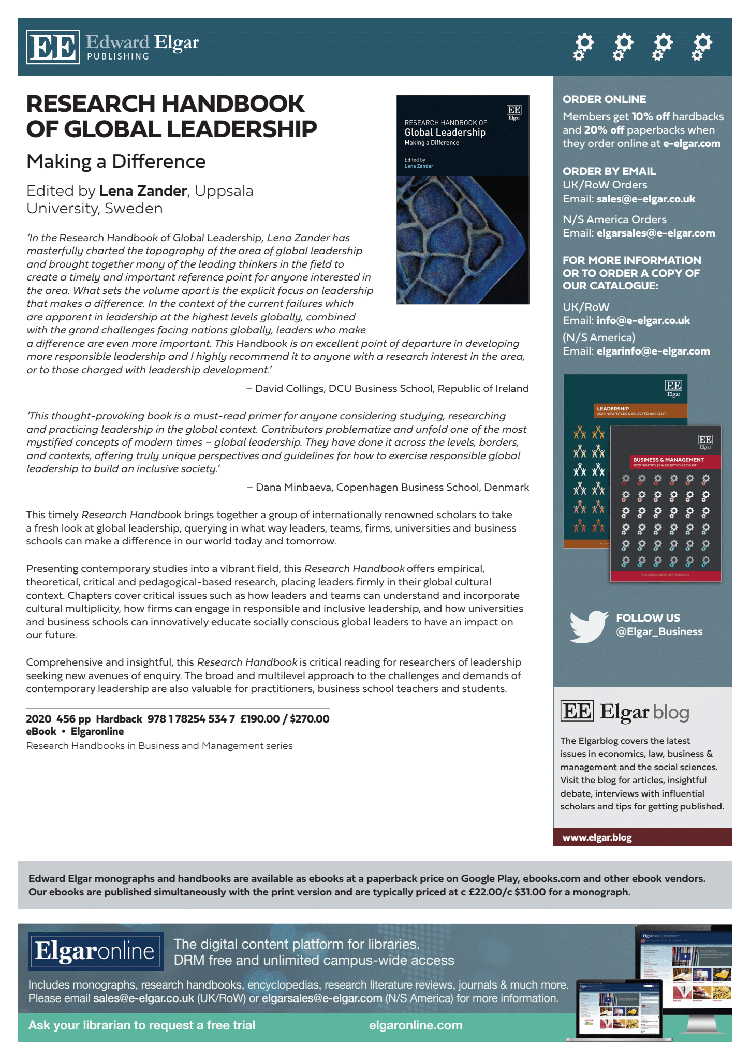
I am pleased to be a part of a recently published book, the Research Handbook of Global Leadership: Making a Difference (Lena Zander, Ed.). The book’s publication is timely, as leadership in these uncertain times becomes ever more important. Many international organizations are and will be facing numerous challenges and will need to develop new strategies, skills and ways to overcome them. More than ever before true leadership will need to include skills to navigate an uncertain landscape, while simultaneously demonstrating compassion, inclusivity, social consciousness, and responsibility across an even greater number of boundaries and contexts.
I have contributed to three chapters in this book. In Chapter 4, Action intent: Getting closer to leadership behavior in 22 countries, 23 authors examine how leaders make the choices they do in a study of 1,868 leaders worldwide. In Chapter 9, The new Millennial global leaders: What a difference a generation makes!, Butler, Sutton, Mockaitis and Zander examine inter-generational workplace relations, the characteristics of millennial generation employees and the future of work and global leadership facing this generation. In Chapter 24, A world of learning: The future of management education based on academia and practitioner universitas, Zettinig, Zander, Zander and Mockaitis discuss the future of management education, especially the way current and future leaders are “trained” to acquire standardized skill sets and offer some ideas for enhancing the relevance of leadership learning.
All of the book’s 25 chapters, by renowned scholars in the field, add to the global leadership domain by offering novel insights into “making a difference.”
TAP YOUR VIRTUAL TEAM’S POTENTIAL.
More and more organizations are tapping into the benefits of virtual teams to achieve cost efficiencies, greater flexibility and faster turnaround times for complex projects. Managing an international virtual team has numerous challenges associated with physical, temporal and cultural distance, yet, in many industries, global virtual teams are fast becoming organizations’ raison d’etre, a new form of organizing work that helps both large and small firms quickly respond to global client demands and outperform their more traditionally focused competitors. Rapid, flexible and innovative solutions are a real possibility with global virtual teams. When managed the right way, global virtual teams can outperform traditional project teams. They can be used to bring people together across an organization’s global locations, who would not normally be able to meet. They can tap into and combine resources – ideas, expertise, information, people and technologies – across functions, departments and layers in different countries that would otherwise be very expensive to do. And, by doing so, they can achieve greater creativity, innovativeness and performance. How can a global virtual team achieve its maximum potential to unleash creative and innovative performance-enhancing solutions? Based on our own research on hundreds of global virtual teams over the years, there are three key factors that interact and have the potential either to provoke underperformance or to generate exceptional performance.
Diversity.
Diversity of backgrounds, nationalities, attitudes, expectations, values and other characteristics can make or break the team from the start. A different understanding by team members of just about anything that occurs in the team can quickly escalate into an irreparable misunderstanding. Delays in communication may also cause minor issues to linger and potentially lead to conflict. However, diversity also has the ability to amplify the team’s creative potential. Different ideas, backgrounds, experiences and skills across different countries can have a positive multiplier effect. But leveraging diversity is not that easy. It is important that team members, and leaders especially, have some degree of sensitivity to diversity and cultural differences. In other words, they must possess cultural intelligence.
Trust.
Trust is important in any team, but it is extremely so in global virtual teams. When so much communication takes place remotely, asynchronously, and when members cannot always see one another, the phrase “say what you mean and mean what you say” takes on a new meaning. Just like the paradox of diversity, trust in global virtual teams can be built almost instantly, or it can become almost impossible to attain. And it is as much affected by diversity and the team’s ability to meld differences, as by the type of leadership in the team.
Leadership.
We have often seen leaders of global virtual teams throw their arms up in frustration and complain that no matter what approach they take, they just cannot bring the team members together, meet their individual expectations and worry about key project goals at the same time. Different preferences for communicating, coordinating activities, supervising the work, setting goals, interacting and approaching the task by team members were just some of the challenges team leaders needed to juggle. Adapting one’s style to suit all team members seems impossible for one team leader, especially when deadlines await. And trying different approaches takes time. Global virtual team leaders should not hesitate to release the reins when needed and allow another member, who has the expertise or can meet members’ culture-driven expectations, to step in. Sometimes, sharing leadership with the team is the best solution in global virtual teams; empowering team members to own the team process and be proactive can lead to more team innovation than when a leader tries to be all things to all members. There is no formula for global virtual team success. However, leveraging diversity, developing trust and sharing leadership when necessary in global virtual teams are three potential challenges that, when overcome, could transform the global team from one in which people feel thrown together to complete the project, to one in which members combine their unique and diverse resources to generate innovative solutions that set the firm apart from the competition.
 Professor Audra I. Mockaitis