
Home » Posts tagged 'immigration'
Tag Archives: immigration
Diaspora & Cultural Identity
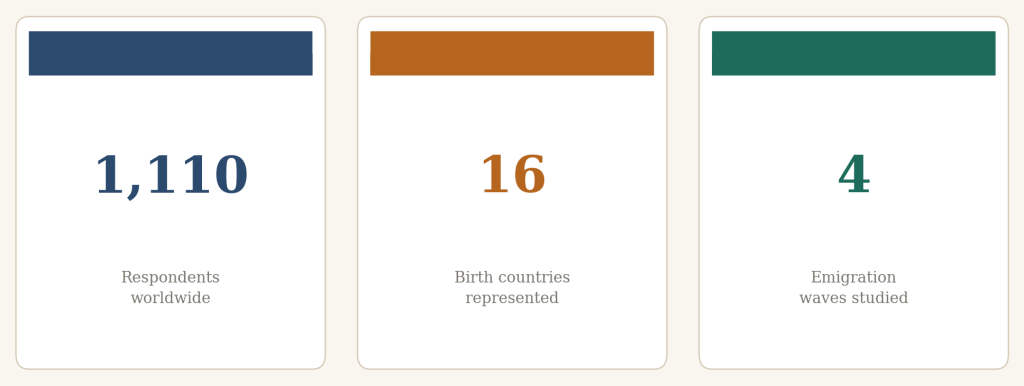
I surveyed over 1,100 Lithuanian migrants worldwide expecting to find cultures drifting apart across generations. What we found was more surprising.
The story we usually tell about diaspora goes something like this: a people displaced from their homeland carry its culture with them, transmit it to their children, and over generations it slowly fades as they assimilate into their host countries. The Lithuanian diaspora, consisting of waves of wartime refugees, Soviet-era exiles, and more recent economic migrants scattered across continents, seemed to be the perfect setting for testing that story. It turned out to complicate it considerably.
What we found
We measured individual-level cultural values across five dimensions: collectivism, uncertainty avoidance, power distance, masculinity, and long-term orientation, comparing Lithuanian-born migrants, foreign-born diaspora members, and nonemigrant home country nationals.
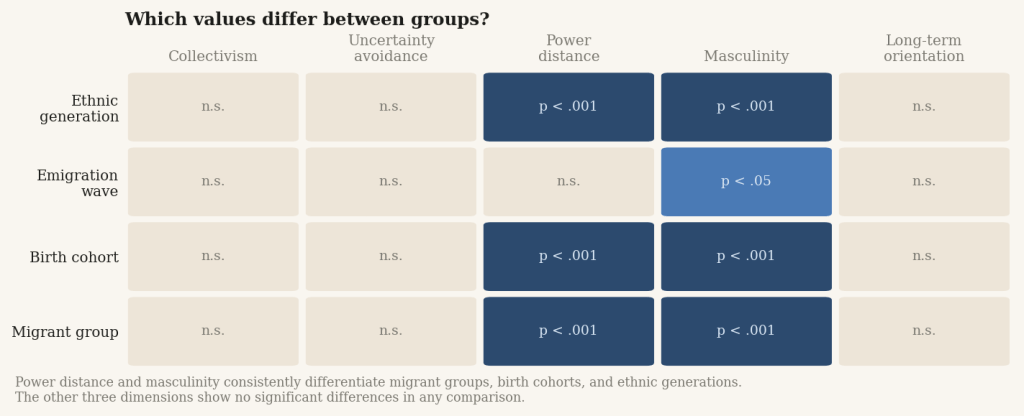
On three of the five dimensions, the groups were strikingly similar. Collectivism, uncertainty avoidance, and long-term orientation showed no significant differences across generations, emigration waves, or migrant groups. Values that one might expect to erode over decades of living abroad appear, instead, to hold.
Three of five cultural values showed no significant differences between migrants and nonemigrants, regardless of how long ago, or from where, people left.
The differences that did emerge were on power distance and masculinity. Lithuanian-born migrants score higher on both than foreign-born diaspora members, and the generational pattern is clear: older cohorts, who came of age under Soviet rule or post-independence economic turbulence, endorse hierarchy and assertiveness more strongly than younger cohorts socialized in more open, prosperous conditions. This is consistent with what we know about values formation: people carry the imprint of the world they grew up in.
The bigger question
Perhaps the most counterintuitive finding is about timing. We might expect post-war diaspora members, who have been separated from Lithuania for decades, unable to return, to have drifted furthest from home country values. They have not, at least not on most dimensions. The differences between emigration waves are modest. What appears to matter more than when people left is the simple fact that they left at all: migrants as a group differ from nonemigrants in consistent ways, regardless of wave or generation.
This has implications well beyond the Lithuanian case. International business research routinely treats national culture scores as if they describe a homogeneous group. Behind any national average lie subgroups shaped by radically different histories – people who fled, people who chose to go, people born abroad to parents who fled. Collapsing those distinctions into a single number discards exactly the variation that tells us something interesting about how culture actually works.
See:
Mockaitis, A.I., & Zander, L. (2023). Dissecting generations of migrant identities within a diaspora. In: A.I.Mockaitis (Ed.). The Palgrave Handbook of Global Migration in International Business, Palgrave Macmillan, Cham. https://doi.org/10.1007/978-3-031-38886-6_6
 Professor Audra I. Mockaitis